
Measurement Book (MB) Format for Construction: How to Record Work Done
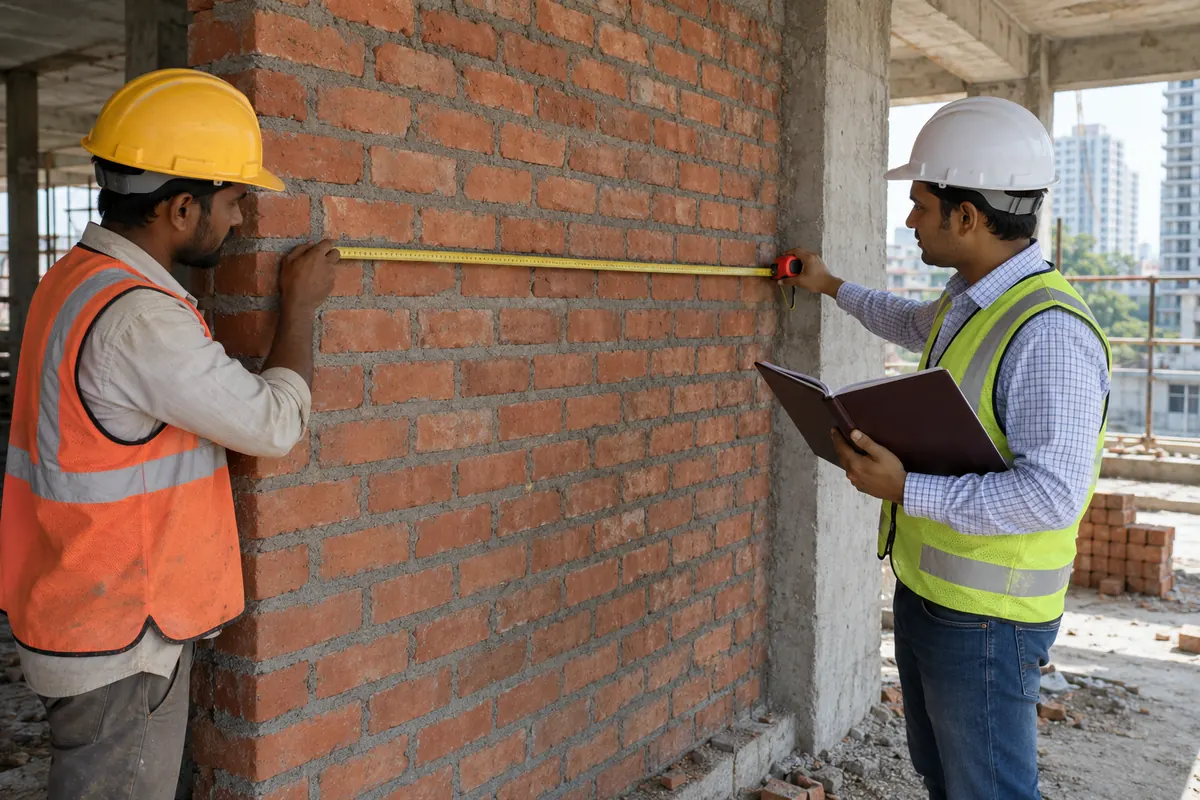
A contractor submits a running bill, but the quantity in the bill does not match the work at site. The client checks the wall length again. Openings were not deducted. The plaster area is mixed with brickwork volume. The bill is held back until the measurement is corrected. A properly written measurement book, usually called an MB, helps prevent this problem.
What a measurement book is
A measurement book is the site record of work actually completed. It contains the dimensions, calculations and accepted quantities for each item. These quantities support contractor bills, client bills, subcontractor settlements and cost checks.
The MB is different from a BOQ. A BOQ states the planned item description and estimated quantity. The MB records what was measured after execution. For example, the BOQ may contain 100 cubic metres of brickwork. The MB may show that 28.450 cubic metres has been completed and checked up to the billing date.
Measurements should be taken jointly whenever possible. The site engineer, contractor representative and client or consultant can check the same work before it gets covered. This is especially important for foundations, reinforcement, waterproofing and concealed services.
A good MB creates a clear trail from the site to the bill. Anyone checking it should understand where the work was done, how it was measured, which rate item applies and who accepted the entry.
The MB format, column by column
The exact layout can change between companies and contracts. However, a practical construction MB should contain the following fields.
| Column | What to enter | Why it matters |
|---|---|---|
| MB reference | Book number, page number or digital entry number | Connects the measurement with the bill and supporting records. |
| Date | Date of measurement | Shows the billing period and when the work was checked. |
| Project and location | Site name, floor, room, grid or chainage | Prevents quantities from different areas being mixed. |
| BOQ item | Item number and approved description | Connects the measured work with the correct rate. |
| Measurement details | Number, length, breadth or width, height or depth | Shows the actual dimensions used in the calculation. |
| Unit | m, sqm, cum, kg, number or another contract unit | Keeps the calculation consistent with the BOQ. |
| Gross quantity | Quantity before deductions | Makes the main calculation easy to verify. |
| Deductions | Openings, voids or work not payable under the item | Prevents overstatement of the payable quantity. |
| Net quantity | Gross quantity minus deductions | Provides the quantity carried into the bill. |
| Remarks | Drawing reference, variation, level or site condition | Explains unusual measurements and changes. |
| Checks and signatures | Names and acceptance by the responsible people | Records who measured, checked and accepted the work. |
Write the full location instead of a vague note such as “first-floor wall.” A better entry is “First floor, bedroom 2, wall between grids B2 and B3.” If a revised drawing was used, record its number and revision.
A worked example for brickwork and plaster
Stop juggling WhatsApp groups, Excel sheets, and paper registers
Trackovo runs every part of your construction site in one app — materials, attendance, finance, vendor payments. 14-day free trial. No card needed.
Start your free trial →Brickwork measured in cubic metres
Suppose a brick wall is 5.000 m long, 0.230 m thick and 3.000 m high. It has one door opening measuring 1.000 m wide and 2.100 m high. The opening passes through the full wall thickness.
Gross brickwork: 5.000 x 0.230 x 3.000 = 3.450 cum.
Door deduction: 1.000 x 0.230 x 2.100 = 0.483 cum.
Net brickwork: 3.450 – 0.483 = 2.967 cum.
The MB should show the wall and opening on separate lines. Do not write only the final quantity. The checker needs to see how 2.967 cum was obtained. Follow the contract measurement rules for small openings, lintels, embedded items and other deductions. Do not assume that every contract treats them in the same way.
Plaster measured in square metres
Now measure plaster on one face of the same wall. The wall face is 5.000 m long and 3.000 m high. The door opening is 1.000 m by 2.100 m.
Gross plaster area: 5.000 x 3.000 = 15.000 sqm.
Door deduction: 1.000 x 2.100 = 2.100 sqm.
Net plaster area: 15.000 – 2.100 = 12.900 sqm.
If plaster is completed on both faces, record each face clearly. Also record jambs, soffits or bands separately when the BOQ or contract requires separate measurement. Mention the plaster thickness and finish in the description, such as internal cement plaster of the specified thickness.
Seven mistakes that get a bill rejected
- Using a vague location. The checker cannot confirm which wall, slab or room was measured. Use floor, grid, room and drawing references.
- Mixing units. Brickwork may be measured in cum while plaster is measured in sqm. A correct dimension with the wrong unit still produces a wrong bill.
- Showing only the total. A lump-sum quantity without dimensions is difficult to verify. Record number, length, width, height and deductions.
- Missing openings or voids. Doors, windows, shafts and unexecuted portions may need deduction. Apply the measurement rules stated in the contract.
- Measuring from an old drawing. Site execution may follow a revised drawing. Record the revision used and check actual dimensions.
- Combining different BOQ items. Different thicknesses, mixes, floors or finishes may have different rates. Keep them on separate lines.
- Taking measurements too late. Concealed work becomes difficult to verify after covering. Measure it before concreting, plastering, backfilling or closing a false ceiling.
Arithmetic and rounding also need a common rule. Decide the number of decimal places required by the contract. Use the same method in the MB, abstract sheet and bill.
Paper MB against digital MB
| Point | Paper MB | Digital MB |
|---|---|---|
| Site use | Simple to carry and familiar to many engineers. | Useful when the team already records site work on phones or computers. |
| Calculation | Arithmetic is written and checked manually. | A digital system can reduce repeated calculation, depending on how it is set up. |
| Corrections | Corrections must remain visible and be initialled. | Changes should retain a clear review and approval trail. |
| Sharing | Pages must be copied, scanned or photographed. | Records can be shared more easily when access and export options are available. |
| Risk | Pages can be damaged, misplaced or become hard to read. | Poor naming, access control or data entry can still create confusion. |
A sheet also does some jobs well. It is flexible, familiar and suitable for a small number of measurements. You can start with the available construction Excel templates. However, a sheet needs careful version control. If the site engineer, billing engineer and office keep separate copies, nobody may know which quantity is final.
How the measurement book works in Trackovo
Trackovo includes a measurement book in the same app used for material, labour, expenses, tasks and daily progress. This helps keep measured work closer to other site records. A team can also manage material requests, approvals, orders, receipts and stock; labour attendance and wages; contractor settlement; site-wise payments; vendors; machines and tools; and client updates.
Before adopting any digital MB, test your own items. Enter a wall with a door deduction, a plaster measurement and a revised quantity. Check how your team will review entries and use the final quantity for billing. Trackovo’s features page gives the broader module list. You can also request a demo to see the current measurement-book workflow and confirm that its output fits your client’s required format.
If your existing measurements are in Excel, the Trackovo team helps import data from Excel. Your data can also be exported on request. Keep the signed record required by your contract, even when daily measurements are maintained digitally.
Common questions
What is the difference between an MB and a BOQ?
A BOQ lists planned work items, estimated quantities and the basis for rates. An MB records the dimensions and quantities actually executed at site. The MB quantity supports the bill against the relevant BOQ item.
Who should write and sign the measurement book?
The responsible site engineer normally records or verifies the measurement. The contractor representative and client, consultant or authorised checker should accept it as required by the contract. The exact signing process depends on the project.
How many decimal places should an MB use?
Use the rounding rule stated in the contract, BOQ or client procedure. Apply it consistently. Do not use one precision in the detailed measurement and another in the bill without showing the adjustment.
Can Excel or an app replace a paper measurement book?
It can replace much of the recording and calculation work if the client accepts the process. First confirm contractual requirements for signatures, approvals and record retention. For important bills, keep an agreed audit trail and a final accepted copy.
Ready to stop the WhatsApp chaos? Try Trackovo free for 14 days.
Start free trial →